FluxScript
Phonetic Stenography
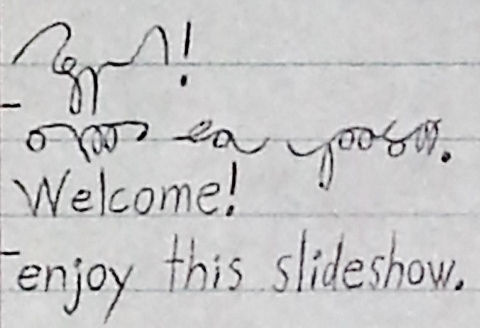
Text transliterated into FluxScript Phonetic Stenography

This sentence contains all the basic English phonemes, and therefore includes all the characters of FluxScript

The slideshow will now repeat
Text transliterated into FluxScript Phonetic Stenography


Hover over the slides for more information
How I Came to Create FluxScript:
My interest in alternative orthographies began in June 2013, and FluxScript was created by the end of the summer. After passing all my tests at the end of a brutal school year, I became bored and turned to challenging myself by learning novelty skills, specifically including Marc Okrand's Klingonese from Star Trek. Klingon phrases are written with either Latin characters or the Klingon alphabet (named 'pIqaD' or ' ').
This lead me to another well-known invented language and its writing system, namely J. R. R. Tolkien's Sindarin and Tengwar from The Lord of the Rings. I appreciated Tengwar's aesthetic and phonographic details and studied the method of transliterating English to Tengwar. After studying phonics deeply, I began transliterating texts for fun, and learned also to write in Cirth. I quickly learned the plain fact that certain writing systems take longer to read and write than others.
After realizing this fact, I began searching for a faster way to write English. With a simple web search I stumbled upon Eric Lee's Handywrite, which I quickly picked up, and just as quickly left alone. I admired Lee's enthusiasm for improving orthography, and his comprehensive explanations, but I personally could not handle scribbling wide areas of paper for each speedy word. I began looking at other writing systems including alphabetic shorthand, Teeline, and even Blissymbolics. None of them fit quite what I was looking for.
I decided that a writing system worth learning to me would use:
-
simple cursive handwriting strokes to improve speed and physical acquisition
-
phonetic symbols to increase mental acquisition
-
linear arrangement to increase readability
-
synergistic, yet distinct characters to increase fluidity without losing readability
-
characters which never cross (as with cursive g above b), to reduce confusion
Noting both Tolkien's and Lee's approach to assigning characters to sounds, I began formulating characters. Below is my first product after about ten attempts and alterations. I planned on calling the system 'Streamline.'
Here I'll list some of the thoughts that went into assigning characters:
-
plosives should look sharp to match their sound, and be the simplest to write because they are common
-
fricatives should be looped to reflect their airy derivation of the plosives
-
nasals and semivowels should look like weak, smooth characters, which also happen to blend physically with other characters as they do phonetically
-
T should be the simplest to write as it occurs commonly
-
adding voice to a sound is represented well with a slant to the characters
-
English doesn't use velar fricatives, so those spots are free for any character, but preferably including H
-
open slants are harder to write so they should be the less common nasals, or semivowels
-
the small loops for TH and DH, and SH and ZH look rather similar, but traditional spelling naturally associates them closely as well, making it a less serious problem
-
K and G are more common than CH and J, so perhaps K and G should be given the shorter stems. However, SH/ZH's characters would have to be replaced with letters that are much more dissimilar (therefore K and G kept their long stems).
-
vowels should be round and easy to spot, thus they were given a central position. E was set to be reminiscent of cursive E. A paralleled E's sound, and so parallels the shape. I sounds like E, and sounds shorter than O, and so was given the other short symbol. The schwa (as in putt) is extremely common and easily neglected so should have an extremely simple shape. I had to find a centralized shape for the U's, which fortunately are uncommon. Long vowels are doubled.
-
any remaining diphthongs could be constructed
-
the idea for the ending S was derived from Tolkien and Lee's scripts.
-
further shortcuts were derived. of the was specially derived to pay homage to my main inspiration, Tengwar.
As I continue to write in FluxScript, I relentlessly wonder about ways to improve it, but I've grown genuinely happy with the writing system and have only ended up developing a rich selection of derived shortcuts.
Thank you indefinitely for your interest,
Brett B.
Creation and Inspiration

