FluxScript
Phonetic Stenography
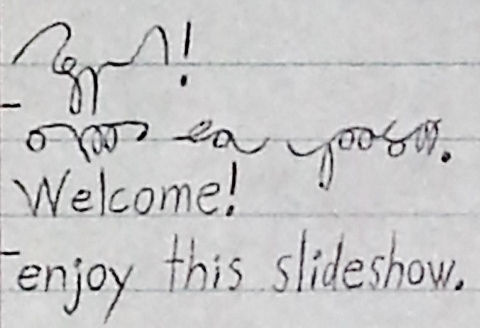
Text transliterated into FluxScript Phonetic Stenography

This sentence contains all the basic English phonemes, and therefore includes all the characters of FluxScript

The slideshow will now repeat
Text transliterated into FluxScript Phonetic Stenography


Hover over the slides for more information
Consonant Blends:
FluxScript utilizes 95 ligatures (contextually blended characters) to improve writing speed without reducing legibility. That means over 50% of English's 185 consonant blends can be written even quicker! This is most often achieved by omitting the baseline connection. While the following ligatures are not required to create a word, they are extremely helpful once mastered. All ligatures can unambiguously replace the corresponding phonemes in any common words (e.g. plug could not be read lpug, and gulp could not be read gupl). Ligature properties observed to the right can be used to link codas (ending consonants) to onsets (beginning consonants).
The Auxiliaries:
Certain common words and sounds are common enough to afford special character sets. The sounds of KH (as in loch), and HW (as in which) are only pronounced in some dialects, and should only be written if intended to be pronounced.
Some explanation is due for -S, -ED, NGK and NGG:
-
-S is the suffix S/ES in words such as cats, foxes, runs, and dances, but is not used in toss, his, its, it's, or person's.
-
-ED is the suffix in beached or landed, and is written the same as any ending D.
-
NGK is the sound in think.
-
NGG is the sound in the middle of finger, but not in singer.
Introduction to FluxScript


Overview:
FluxScript is a system of phonetic (speech sound) stenography (fast writing), designed to quicken writing speed with a bit of practice. Here's what sets this script apart:
-
simple cursive handwriting strokes to improve speed and physical acquisition
-
phonetic symbols to increase mental acquisition and speed
-
linear arrangement to increase readability
-
synergistic, yet distinct characters to increase fluidity without losing readability
-
characters which never cross (as with cursive g above b), to reduce confusion
Each symbol indicates one English (American) sound, so you don't have to write all those silent letters that traditional longhand uses (the word 'though' employs six characters for about two sounds). This concept is shared by well-used stenographic systems including Pitman's and Gregg's Shorthand. FluxScript differs from other stenographic alphabets in that its characters only progress linearly (as with Latin characters) which improves readability. The shapes of FluxScript letters match the patterns of the sounds they represent. FluxScript is best written on wide ruled notebook paper, as its characters are categorized by their distance from the baseline (though it may also be written freehand). As the reader's eyes scan across each line of FluxScript, they can quickly judge the shape, size, and angle of each symbol in a word. Characters that sound similarly appear similarly so that slight misspellings can be easily corrected by the mind.
By learning to write based on sounds rather than traditional spellings, you will gain writing speed (presumably twice as fast as longhand) while developing a uniquely satisfying skill. This site will not include shorthand abbreviation (though omitting unnecessary characters would accelerate writing speeds), but rather a new orthographic system for the English language. As a model of a new form of writing, I invite you to adapt this system to fit your individual preferences.
The Consonants:
The consonants are grouped into four sets of six, to match phonetic patterns (though some liberties were taken).
Letters are differentiated by their size, shape, and angle. Voiced consonants are spoken the same way as their
unvoiced counterparts, but with vibration of the vocal chords (feel your throat as you make the F and V sounds).
Italicized characters should be written at an approximate 45° angle. Long stems are the size of one x-height, while
short stems reach half as high. To learn the sound of each consonant, refer to its categorized explanation lower on
this page.
The Vowels:
In standard English orthography, we learn five basic vowels (A, E, I, O, and U), but the fact is that English contains
about eleven distinct vowel sounds. Vowels are identifiable by their loop which crosses through the baseline. Short
vowels are composed of one loop while long vowels contain two loops. Subsequent blends can be created with their
phonetic parts. To see how vowels are connected to consonants, look at the examples in Writing Exercises.
note: the character blends are derived from their phonetic parts except for the YU sound in mute, which is simplified
Plosives Explained:
T, D, P, B, CH, J, K, and G are the percussive consonants, in which your tongue almost fully stops the air flow in your
mouth, builds up pressure, then releases the pressure in one ex'plosive' action.
Fricatives Explained:
TH, DH, F, V, SH, ZH, S, Z, and H are weaker than plosives, characterized by the incomplete blocking of air flow
as your mouth causes 'fric'tion.
Nasals Explained:
N, M, and NG occur when air flow is redirected from the mouth through the nasal cavity.
Semivowels/ Liquids Explained:
Y, W, L, and R sound half like vowels but are a bit more restricted in their air flow.
Looking for characters for numbers, punctuation, or unique sounds? Stick to traditional symbols, or create your own!


